

Daily Duas
Dua Before Leaving the Toilet
Quick answer
غُفْرَانَكَ
Ghufranaka
"I seek Your forgiveness."
Aisha (RA) · Ibn Majah 300, Abu Dawud 30, Tirmidhi 7 · graded Sahih
Two very short duas cover the whole visit to the toilet — one said just before stepping in, one just after stepping out. Tap below for the full Arabic, the hadith sourcing, the etiquette, and the questions people actually ask.
Is Ghufranaka Authentic? (Hadith Source)
Aisha (RA) reported that when the Messenger of Allah ﷺ came out of the toilet, he would say "Ghufranaka." It's recorded in Sunan Abi Dawud 30, Jami' at-Tirmidhi 7, and Sunan Ibn Majah 300 — graded Sahih directly, with a full chain of narration. It's also in Bulugh al-Maram 100, where Ibn Hajar records that the hadith scholars Abu Hatim and Al-Hakim both graded it Sahih.
كَانَ رَسُولُ اللَّهِ ﷺ إِذَا خَرَجَ مِنَ الْغَائِطِ قَالَ: غُفْرَانَكَ
"When the Messenger of Allah ﷺ exited the toilet, he would say: Ghufranaka (I seek Your forgiveness)."
Sunan Ibn Majah 300 — Sahih
Dua Before Entering the Toilet
Since almost everyone searching for the "leaving" dua also wants the "entering" one, here it is too.
بِسْمِ اللَّهِ، اللَّهُمَّ إِنِّي أَعُوذُ بِكَ مِنَ الْخُبُثِ وَالْخَبَائِثِ
Bismillah, Allahumma inni a'udhu bika minal khubthi wal khaba'ith
"In the name of Allah. O Allah, I seek refuge in You from male and female devils."
Anas ibn Malik (RA) · Sahih al-Bukhari 142, Sahih Muslim 375 — agreed upon
A quick note on the "Bismillah" opening: it's based on a separate hadith about a "screen from the jinn" (Tirmidhi 606, Ibn Majah 297). Scholars have genuinely disagreed on how strong this specific report is — so it's best described as a widely-recommended addition, not part of the agreed-upon core wording.
Before Entering vs After Leaving
| Before Entering | After Leaving | |
|---|---|---|
| Arabic | بِسْمِ اللَّهِ، اللَّهُمَّ إِنِّي أَعُوذُ بِكَ مِنَ الْخُبُثِ وَالْخَبَائِثِ | غُفْرَانَكَ |
| Meaning | "O Allah, I seek refuge in You from male and female devils." | "I seek Your forgiveness." |
| When | Just before stepping in | Right after stepping out |
| Source | Bukhari 142, Muslim 375 | Abu Dawud 30, Tirmidhi 7, Ibn Majah 300 |
Why Do Muslims Say This?
The protection dua exists because the Prophet ﷺ taught that these places are frequented by shayateen — Zayd ibn Arqam (RA) reported him saying "these toilets are visited," so a person should seek refuge before entering (Abu Dawud 6, Ibn Majah 296).
As for why forgiveness is asked on the way out: scholars have offered a few explanations, one common one being that the toilet is the one ordinary moment in the day when open remembrance of Allah is deliberately paused out of respect — so Ghufranaka marks the return to that remembrance. The Qur'an ties peace of heart directly to remembering Allah ("Verily, in the remembrance of Allah do hearts find rest," 13:28).
Islamic Toilet Etiquette (Sunnah Adab)
- Say the entering dua before you step in.
- Enter with the left foot — etiquette scholars derived from the general Sunnah of preferring the right side for good, pure matters.
- Avoid unnecessary talking while inside.
- Don't face or turn your back to the Qiblah while relieving yourself (Bukhari & Muslim).
- Don't touch the private parts, or clean yourself, with the right hand (Bukhari & Muslim).
- Clean thoroughly with water and/or a suitable material — never bone or dung.
- Avoid stagnant water or places where people walk or rest.
- Exit with the right foot and say Ghufranaka.
A note on the "Alhamdulillah" addition
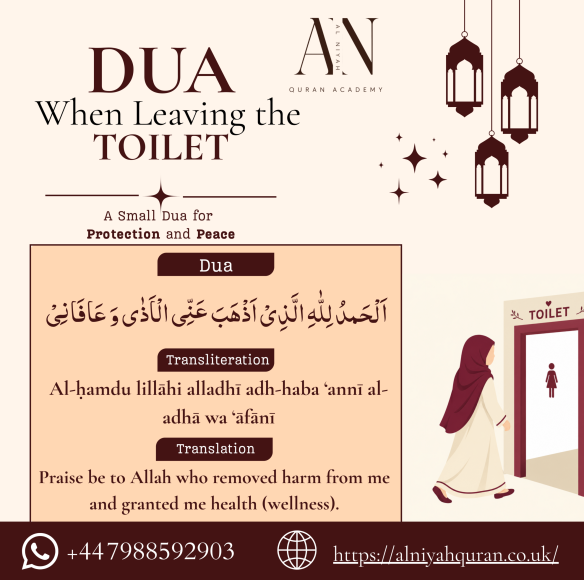
You may see a longer version elsewhere: "Ghufranaka, Alhamdulillahilladhi adhhaba anni al-adha wa afani." The second half isn't part of the same well-established chain — one recorded version (Ibn Majah 3131, from Ibn Abbas) is graded Da'if (weak). This guide treats Ghufranaka alone as the primary, safely-authenticated dua.
Common Mistakes to Avoid
- Saying Ghufranaka while still inside, or the entering dua once already inside.
- Treating the "Alhamdulillah" line as required.
- Mixing up the two duas.
- Waiting for a child's perfect pronunciation before it "counts" — consistency matters more.
Teaching This Dua to a Child
These two duas are usually one of the first pieces of daily adab a child picks up, simply because the moment comes round several times a day. A few things make it stick:
- Keep a small card with the Arabic, transliteration and meaning near the bathroom door — somewhere dry, away from water.
- Say it out loud together every time for the first few weeks, rather than expecting them to remember it alone.
- Explain it in one simple line: "We're saying sorry to Allah, and thanking Him too."
- Praise the habit, not the pronunciation — a confident "Ghufranaka" said slightly wrong beats a perfect one said only when reminded.
- Once this one is automatic, it's usually the easiest daily dua to build the next one on.
FAQs
What is the dua before leaving the toilet?
After stepping out, say "Ghufranaka" (غُفْرَانَكَ) — "I seek Your forgiveness." It's narrated from Aisha (RA) in Sunan Abi Dawud 30, Jami' at-Tirmidhi 7, and Sunan Ibn Majah 300.
Is Ghufranaka authentic (sahih)?
Yes. It's graded Sahih on the Sunan Ibn Majah 300 entry, and in Bulugh al-Maram, Ibn Hajar records that Abu Hatim and Al-Hakim both graded it Sahih.
What's the difference between the dua for entering and the dua for leaving?
The entering dua asks for protection before stepping into an impure place; the leaving dua is a short seeking of forgiveness said right after stepping back out — two separate duas, not one combined phrase.
How do you pronounce Ghufranaka?
Roughly "ghuf-RAA-na-kah" — four syllables in one breath, said quietly right after leaving.
How can I teach this dua to a young child?
Say it together out loud every time for the first few weeks, keep a small visual reminder near the bathroom door, and don't worry about imperfect pronunciation — repetition builds the habit.
Related Duas
Give your child a structured way to learn duas like this
1-on-1 online Qur'an and Islamic Studies classes for kids and adults across the UK — including daily duas, Qur'an reading, and Islamic manners.