

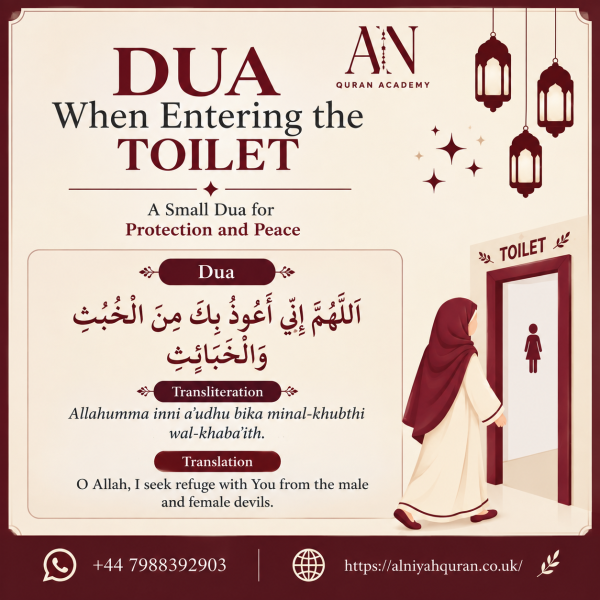
Dua Before Entering the Toilet
A short supplication taught by the Prophet Muhammad (peace be upon him), recited for protection just before stepping into the restroom.
Allahumma inni a'udhu bika minal-khubthi wal-khaba'ith
O Allah, I seek refuge in You from male and female devils.
Agreed upon by Sahih al-Bukhari (142) and Sahih Muslim (375) — one of the strongest gradings in hadith science.
In this guide: what's authentic, the full etiquette, teaching tips, and the FAQs — about eight minutes, start to finish.
What Is This Dua?
The dua before entering the toilet is a short supplication Muslims recite when about to enter a restroom or bathroom. It is rooted in the Sunnah of the Prophet Muhammad (peace be upon him), and serves as a reminder to seek Allah's protection before entering a place where a person becomes physically exposed and vulnerable.
Its core purpose is protection — specifically, seeking refuge from the khubth and khaba'ith, which scholars interpret as male and female devils, or impure spirits. The toilet is considered a place such beings may gather, and reciting this dua is a means of safeguarding oneself.
Unlike many daily duas that are optional but recommended, this supplication carries a strong authentic basis, making it an important practice for Muslims of all ages to build into their daily routine.
Is It Authentic?
Yes — it is among the most authenticated duas in Islamic tradition. The primary narration comes from Anas ibn Malik (RA), who reported that whenever the Prophet Muhammad (peace be upon him) entered the toilet, he would say this exact dua.
This hadith is recorded in both Sahih al-Bukhari (142) — the most authoritative hadith collection in Sunni Islam — and Sahih Muslim (375), the second most authoritative collection.
A second, independent chain of transmission exists through Zayd ibn Arqam (RA), recorded in Sunan Abi Dawud (6) and Sunan Ibn Majah (296) — further strengthening the dua's authenticity.
One clarification worth making: no verse of the Qur'an mentions this dua word-for-word. The Qur'an addresses purification in general terms, such as in Surah Al-Baqarah (2:222), but the exact wording comes entirely from the hadith of the Prophet (peace be upon him). That's completely normal — many daily supplications are hadith-based rather than direct Qur'anic verses.
Arabic Text, Transliteration & Meaning
Here is the dua broken down word by word, for anyone who wants to understand — not just memorise — what they're saying.
Allahumma inni a'udhu bika minal-khubthi wal-khaba'ith
| Arabic | Meaning | Notes |
|---|---|---|
| اللَّهُمَّ | O Allah | A form of address used only in supplication |
| إِنِّي | Indeed, I | Emphasises the personal nature of the request |
| أَعُوذُ | I seek refuge | From the root ʿ-w-dh: to take shelter or protection |
| بِكَ | In You | Seeking protection directly from Allah |
| مِنَ | From | Indicates the source of harm being sought against |
| الْخُبْثِ | Male devils / impurity | The evil beings and the spiritual filth linked to them |
| وَالْخَبَائِثِ | Female devils / impurities | Feminine plural, completing the paired concept |
Pronunciation tip: the "kh" sound (خ) is pronounced from the back of the throat, like the Scottish "loch" or German "Bach." The "th" at the end of khubthi and khaba'ith is soft, as in the English word "thin" (not "this").
Do You Say "Bismillah" Too?
Many Muslims say "Bismillah" as well, but it comes from a separate hadith with a disputed chain of transmission — it isn't part of the core dua agreed upon by Bukhari and Muslim.
A narration attributed to Ali ibn Abi Talib (RA) reports the Prophet (peace be upon him) as saying:
The screen between the eyes of the jinn and the nakedness of the children of Adam is that when one of them enters the toilet, he says: "Bismillah."
Recorded in Sunan Ibn Majah (297) and Jami' at-Tirmidhi (606).
Scholars diverge on the strength of this chain. Imam At-Tirmidhi called it gharib — unusual, not strong — and did not grade it as authentic. Some later scholars classified it as da'if (weak) over concerns about specific narrators. Shaykh al-Albani, a prominent modern hadith scholar, graded it sahih (authentic) in his evaluations of Sahih al-Tirmidhi and Sahih al-Jami.
Say "Bismillah" as well
The hadith exists in Ibn Majah and Tirmidhi, and some scholars consider it authentic. Treat it as a recommended precaution, not an obligation.
Stick to the core dua
Focus only on the agreed-upon Bukhari and Muslim hadith. This alone is fully sufficient and unquestionably authentic.
Our take: say "Bismillah" if you wish — it's a valid practice many respected scholars endorse. Just know that the one unquestionable dua is the one recorded in Bukhari and Muslim; the Bismillah addition comes from a separate, weaker chain.
Islamic Toilet Etiquette
The dua before entering is just one part of a wider set of Islamic manners (adab) around using the restroom — practices rooted in the Sunnah that reflect how comprehensive Islamic guidance is, covering even the most private and routine parts of daily life.
Left foot in, right foot out
A well-established Sunnah principle: the left foot for entering places considered unclean, the right for good and blessed actions. Scholars of fiqh have consistently applied this to the toilet.
Avoid facing the Qiblah
In the open — not inside a walled structure — it's forbidden to face the Ka'bah's direction or turn one's back to it. Indoors, where the act is concealed, this ruling is generally considered less applicable.
Seek privacy
The Prophet (peace be upon him) discouraged speaking, greeting others, or conversing while in the toilet. The focus is on completing one's need with dignity and discretion.
Use a screen or cover
Where practical, the Sunnah recommends using a screen or cover to maintain modesty and privacy.
Perform istinja' (cleaning)
Thorough cleaning with water, or tissue, after relieving oneself is essential to Islamic purification — connected to the validity of wudu and prayer.
"Right for good, left for the opposite" appears throughout Islamic practice — eating, drinking, entering the mosque, and entering the toilet. It's a small, consistent way of embedding spiritual awareness into everyday physical actions.
Teaching Children This Dua
For many Muslim families, this is one of the very first Islamic routines a child learns, simply because children visit the toilet several times a day. Here's what actually works, in practice:
- Say it together, every single time — children learn through repetition and imitation more than formal lessons.
- Start with the transliteration if Arabic feels difficult at first, and break the phrase into small chunks.
- Keep the explanation age-appropriate — "we ask Allah to protect us and keep us safe" is enough; there's no need to frighten a child with talk of jinn.
- Connect it to duas they already know, like the one before eating or sleeping — it's just another way of asking Allah for protection.
- Reassure them that forgetting isn't a sin. It's a sunnah, not an obligation, and a parent can say it on a young child's behalf.
Say it for them
"Allahumma inni a'udhu bika minal-khubthi wal-khaba'ith" — model the full dua first.
Break it into two parts
"Allahumma inni a'udhu bika" — then "minal-khubthi wal-khaba'ith."
Repeat, one part at a time
"Now you try: Allahumma inni a'udhu bika…"
Practice together, every time
Say it together just before entering, so it becomes automatic.
Praise and encourage
"Masha'Allah, you remembered!" — encouragement works far better than correction.
What About After Leaving? (Ghufranaka)
This guide focuses on entering the toilet, but many readers naturally ask about leaving it too — so here's the short version.
Ghufranaka
I seek Your forgiveness.
Narrated by Aisha (RA), recorded in Abu Dawud (30), Tirmidhi (7), and Ibn Majah (300).
Said immediately upon stepping out, ideally with the right foot first. Imam Tirmidhi graded it hasan gharib (good/unusual), and Imam al-Nawawi treated it as authentic.
Frequently Asked Questions
The authentic dua is "Allahumma inni a'udhu bika minal-khubthi wal-khaba'ith" — "O Allah, I seek refuge in You from male and female devils." It's recited just before stepping into the toilet.
Yes. It's agreed upon by Sahih al-Bukhari (142) and Sahih Muslim (375), one of the highest gradings in hadith science. A second, independent narration also appears in Sunan Abi Dawud and Sunan Ibn Majah.
Many Muslims do, based on a separate hadith (Ibn Majah 297, Tirmidhi 606) about a screen between the eyes of the jinn and one's nakedness. Scholars are divided on that hadith's strength, so it's a recommended precaution rather than an authenticated part of the main dua.
Not really — both describe saying the dua just before you step through the doorway. Saying it while still outside the door is the most accurate description of the practice.
"Ghufranaka" — "I seek Your forgiveness." It's narrated by Aisha (RA) in Abu Dawud (30), Tirmidhi (7), and Ibn Majah (300).
Left foot in, right foot out — following the wider Sunnah principle of using the right side for good actions and the left for the opposite.
No sin in forgetting. It's a recommended practice (sunnah), not an obligation (fard). It's fine to say it on a young child's behalf, and they can say it next time they remember.
Scholars differ here. The stronger view is that the dua is specifically for times when you intend to relieve yourself. For other purposes it isn't required, though saying it doesn't hurt.
Summary
The dua before entering the toilet — Allahumma inni a'udhu bika minal-khubthi wal-khaba'ith — is one of the most authenticated daily supplications in Islamic tradition, agreed upon by both Bukhari and Muslim. It's a short phrase with a profound meaning: seeking Allah's protection in a moment of vulnerability.
- The core dua is authentic beyond doubt — narrated by Anas ibn Malik, agreed upon by Bukhari and Muslim.
- "Bismillah" is a separate, disputed addition — valid to say, but from a different and weaker chain.
- It's part of a wider etiquette: entering with the left foot, exiting with the right, and maintaining privacy and cleanliness.
- Teaching children just takes consistency — modelling, repetition, and encouragement.
- The dua after leaving is Ghufranaka; the longer addition some sources include is weak.
- Forgetting is not a sin — this is a recommended practice, not a religious obligation.
The best way to make this dua part of your life is simply to start saying it — every time, with intention and awareness of its meaning. Over time it becomes second nature: a small, steady way of keeping Allah's remembrance close throughout the day.