

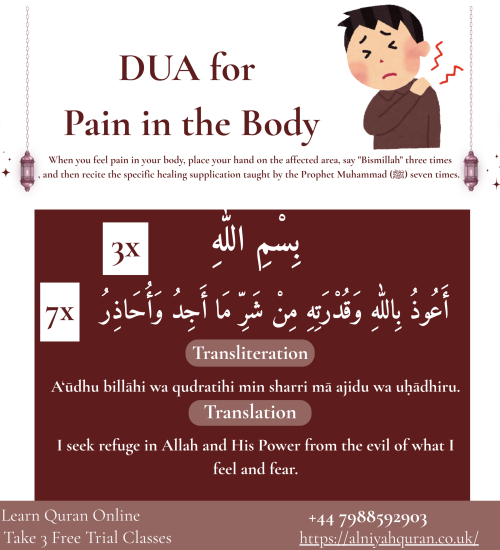
Dua for Pain
A short, specific supplication taught by the Prophet Muhammad ﷺ for physical pain — said with your hand on where it hurts, alongside medical care, never instead of it.
Bismillah (three times) — A'udhu billahi wa qudratihi min sharri ma ajidu wa uhadhiru (seven times)
In the name of Allah — I seek refuge in Allah and His power from the evil of what I feel and what I fear
Taught directly by the Prophet ﷺ to a companion in pain — Sahih Muslim 2202.
In this guide: the sourcing, the full method, the general healing dua, chest pain and toothache, and the FAQs — about ten minutes, start to finish.
What Is the Dua for Pain?
The dua for pain is the one method the Prophet ﷺ taught by name for physical pain, anywhere in the body: place your hand directly on the site of the pain, say "Bismillah" three times, then say "A'udhu billahi wa qudratihi min sharri ma ajidu wa uhadhiru" seven times — "I seek refuge in Allah and His power from the evil of what I feel and what I fear."
The hadith behind it is a personal one. Uthman ibn Abi al-'As (RA) came to the Prophet ﷺ complaining of a pain he had felt in his body ever since he became Muslim. The Prophet ﷺ gave him this exact method in response — and Uthman later said the pain left him, and that he never stopped teaching it to his own family afterwards.
It's this personal, hand-on-the-pain quality that sets it apart from the other duas on this page. It's said by the person in pain, about their own pain, with their own hand marking the spot — which is also why it's worth learning properly rather than half-remembering.
Is It Authentic?
Yes — about as firmly as a hadith can be. This dua is recorded in Sahih Muslim itself (2202, Book 39, Hadith 91), narrated on the authority of Uthman ibn Abi al-'As. Being found directly in Sahih Muslim's own text gives it one of the strongest gradings available in hadith science.
A slightly different wording of the same dua — "A'udhu bi'izzatillahi wa qudratihi" ("I seek refuge in Allah's might and His power") — is recorded separately in Sunan Ibn Majah (3522), through a different chain of narrators. It's worth knowing this variant exists if you come across it, but Sahih Muslim 2202 is the primary, most firmly established version, and it's the one to memorise.
Arabic Text, Transliteration & Meaning
Here's the dua broken down piece by piece, for anyone who wants to understand it, not just repeat it.
Bismillah (×3) — A'udhu billahi wa qudratihi min sharri ma ajidu wa uhadhiru (×7)
| Arabic | Meaning | Notes |
|---|---|---|
| بِسْمِ اللَّهِ | In the name of Allah | Said three times, hand placed on the pain |
| أَعُوذُ | I seek refuge | From the root ʿ-w-dh: to take shelter or protection |
| بِاللَّهِ | in Allah | Refuge sought directly in Allah, not anything created |
| وَقُدْرَتِهِ | and His power | Allah's power over the pain and its cause |
| مِنْ شَرِّ | from the evil | The harm being sought protection from |
| مَا أَجِدُ | of what I feel | The pain exactly as it is right now |
| وَأُحَاذِرُ | and what I fear | Any further harm the pain might bring |
Pronunciation tip: the "dh" in "uhadhiru" is the Arabic ذ (dhal) — a soft, buzzing "th" as in the English "this," not the harder "th" of "thin." The "q" in "qudratihi" is a deep, back-of-the-throat sound (ق, qaf) — heavier than an English "k."
How to Say It, Step by Step
Find the pain
Locate where it hurts and place your hand directly on that spot on your body.
Say Bismillah
Say "Bismillah" three times, keeping your hand in place.
Say the refuge dua
Say "A'udhu billahi wa qudratihi min sharri ma ajidu wa uhadhiru" seven times, hand still on the spot.
Repeat as needed
There's no fixed limit — say the whole sequence again whenever the pain recurs.
The Pain Dua vs. the General Healing Dua
These two get mixed up constantly, so it's worth being precise: they're both authentic, both about physical suffering, but they're two separate hadith with two separate wordings — complementary, not interchangeable.
The Pain Dua
Sahih Muslim 2202. Said by the person in pain, hand on their own body, whenever something specifically hurts.
The General Healing Dua
Bukhari 5750 / Muslim 2191. Said over someone who's unwell — a hand placed on them by another person, asking Allah for healing generally.
Adhhibil-ba'sa Rabban-nas, washfi anta ash-Shafi, la shifa'a illa shifa'uka, shifa'an la yughadiru saqama
Take away the affliction, Lord of mankind, and heal — You are the Healer. There is no healing except Your healing, a healing that leaves no illness behind.
Narrated by Aisha (RA) — Sahih al-Bukhari 5750 and Sahih Muslim 2191a.
Both are true, both are worth knowing — just reach for the right one for the situation you're in.
What the Qur'an Says About Healing
The Qur'an describes itself as a source of healing, and a handful of verses are recited by Muslims specifically for comfort during illness and pain.
Al-Isra 17:82
"And We send down of the Qur'an that which is healing and mercy for the believers." A direct statement that the Qur'an itself carries healing for those who believe.
Ash-Shu'ara 26:80
The Prophet Ibrahim (AS) affirming, "And when I am ill, it is He who cures me." Less a request than a statement of reliance, often recited as a personal reminder of who heals, while unwell.
The Mu'awwidhatayn
Al-Falaq and An-Nas, the two short protective surahs. Aisha (RA) reported that the Prophet ﷺ recited them and blew his breath over his body whenever he fell sick (Bukhari 5016).
Ayat al-Kursi (2:255)
Widely recited at times of distress and illness as a source of comfort and protection — described by the Prophet ﷺ as the greatest verse in the Qur'an (Muslim 810).
Chest Pain & Toothache
"Chest pain" covers two genuinely different things, and getting the split right matters more than getting the Arabic right.
Physical Chest Pain
Treat as an emergency first. Once you're safe and being treated, the pain dua above applies exactly as it does anywhere else — hand on the chest, Bismillah three times, then the refuge dua seven times.
Tightness From Anxiety
A felt heaviness, not sharp pain. The relevant guidance is dhikr — "hearts find rest in the remembrance of Allah" (Ar-Ra'd 13:28) — alongside speaking to a doctor if it's frequent or severe.
Toothache
There's no separate hadith written specifically for tooth pain — it's the same general pain dua, said with your hand on your jaw or cheek near the affected tooth. Some pages add extra steps, like massaging in circular motions or a fixed number tied to the tooth; none of that is in the hadith itself, and inventing detail doesn't make a practice more authentic. Alongside the dua, seeing a dentist for the underlying cause is simply sensible.
Does Dua Replace Medical Treatment?
No — Islamic teaching is explicit that the two work together, not as alternatives.
There is no disease that Allah has created, except that He also has created its treatment.
Sahih al-Bukhari 5678, narrated by Abu Huraira.
Make use of medical treatment, for Allah has not made a disease without appointing a remedy for it, with the exception of one disease, namely old age.
Sunan Abi Dawud 3855, narrated by Usamah ibn Sharik.
In practice: say the dua, and see the doctor, dentist or pharmacist. Neither one is cover for skipping the other — and the outcome, on whatever timeline it comes, stays with Allah.
Does Illness Expiate Sins?
One of the most comforting parts of this teaching, and one of the least shared: pain borne with patience is never wasted.
No calamity befalls a Muslim but that Allah expiates some of his sins because of it, even though it were the prick he receives from a thorn.
Sahih al-Bukhari 5640, narrated by Aisha (RA).
No fatigue, nor disease, nor sorrow, nor sadness, nor hurt, nor distress befalls a Muslim, even if it were the prick he receives from a thorn, but that Allah expiates some of his sins for that.
Sahih al-Bukhari 5641.
This isn't a reason to seek out pain, and it isn't a claim that illness is a punishment — only a reminder that pain carried patiently, alongside dua and treatment, still counts for something.
Duas That Get Mixed Up With Pain Relief
Two well-known Qur'anic duas get relabelled online as "pain relief duas" — worth knowing the difference so you reach for the right one.
The Dua of Prophet Ayyub (AS)
"Indeed, adversity has touched me, and You are the Most Merciful of the merciful" (Al-Anbiya 21:83). A dua for relief from prolonged affliction and hardship generally, drawn from a prophet tested for years — not a hadith taught for momentary physical pain.
Hasbunallahu wa Ni'ma al-Wakil
"Allah is sufficient for us, and He is the best guardian" (Aal-Imran 3:173). A dua of trust said when facing fear, danger or overwhelming hardship — beautiful and authentic, just not the one taught for a headache or a sprained ankle.
Both are worth knowing in their own right — just keep them for their own context, and reach for Muslim 2202 for physical pain itself.
Frequently Asked Questions
Place your hand on the site of the pain, say "Bismillah" three times, then say "A'udhu billahi wa qudratihi min sharri ma ajidu wa uhadhiru" seven times. This is recorded in Sahih Muslim 2202.
Sahih Muslim 2202 is the most specific, taught directly by the Prophet ﷺ for physical pain. The general healing dua in Sahih al-Bukhari 5750 and Sahih Muslim 2191 is also authentic and complements it.
For physical chest pain, use the same pain dua after ruling out an emergency — call 999 for anything sudden or severe. For tightness from anxiety, dhikr and Ar-Ra'd 13:28 are the relevant guidance instead.
There is no toothache-specific hadith. Use the general pain dua from Sahih Muslim 2202 with your hand on your jaw or cheek, and see a dentist for the cause.
Yes — Sahih Muslim 2202 applies generally to any site of pain in the body; only the hand placement changes.
As given in the hadith: Bismillah three times, then the refuge dua seven times. You can repeat the full sequence again if the pain continues or returns.
Reciting the Arabic is preferred, since it preserves the Prophet's ﷺ exact wording, but understanding the meaning matters most, and saying it in English is valid, particularly while learning.
Dua is asking Allah for healing, not a guaranteed cure on a fixed timeline. Uthman ibn Abi al-'As (RA) reported that his pain left him after using this dua, but the outcome, and when it comes, is by Allah's will.
Yes. Islamic teaching explicitly encourages seeking treatment alongside dua — the two are meant to work together, not as alternatives.
Summary
For physical pain, the dua the Prophet ﷺ taught by name is short, specific and firmly sourced: hand on the pain, Bismillah three times, then the refuge dua seven times (Sahih Muslim 2202).
- The core dua is authentic beyond doubt — narrated by Uthman ibn Abi al-'As, recorded in Sahih Muslim itself.
- A separate, equally authentic dua exists for general healing and sickness (Bukhari 5750 / Muslim 2191) — complementary, not interchangeable.
- The Qur'an offers further comfort through 17:82, 26:80, the Mu'awwidhatayn and Ayat al-Kursi.
- Chest pain needs an honest split between the emergency it can signal and the anxiety-related tightness it sometimes means.
- Toothache uses the same general pain dua, alongside a dentist visit for the cause.
- Dua sits beside medical treatment, never instead of it — and pain borne patiently is never without spiritual benefit.
The best way to make this dua part of your life is simply to start saying it — hand on the pain, with intention, next time something hurts.
One Response